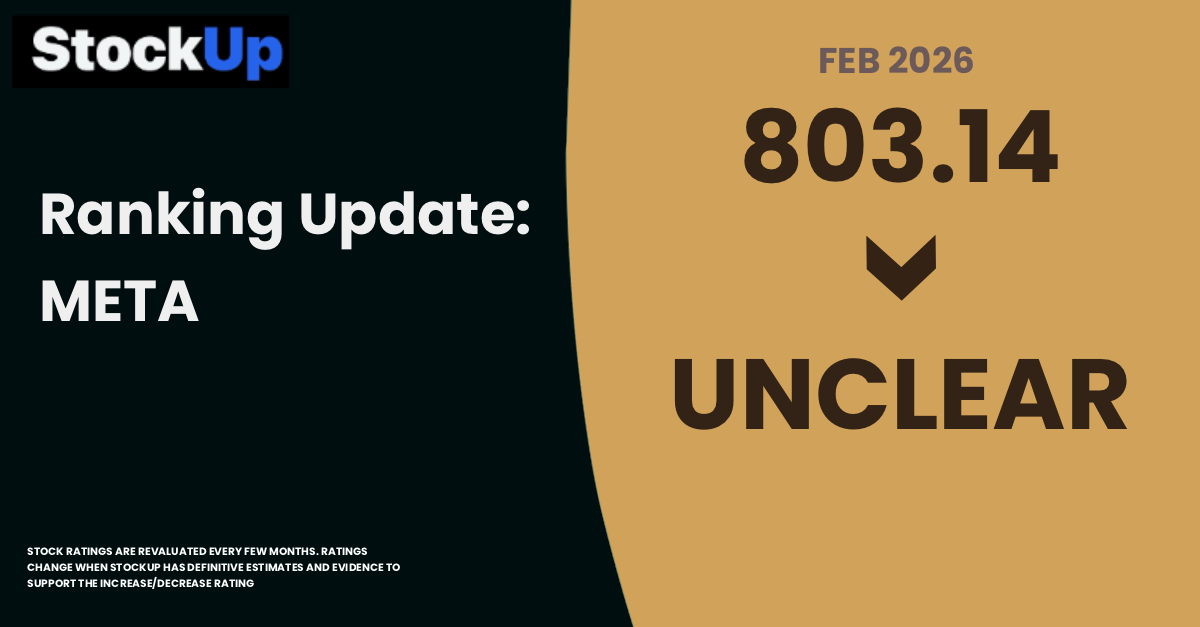
Meta Platforms ($META) has experienced a significant shift in its investment landscape, prompting a re-evaluation of its End-of-Year (EOY) price target from a precise $803.14 to "Unclear." This adjustment reflects heightened uncertainty stemming from several key factors, despite the company's strong Q1 2026 earnings report.
Surging CapEx for AI Infrastructure
A primary driver of this uncertainty is Meta's dramatically increased capital expenditure (CapEx) guidance for 2026, now projected to be in the range of $125 billion to $145 billion, up from a previous forecast of $115 billion to $135 billion. This substantial increase, which at its midpoint is nearly double the company's CapEx in 2025, is largely attributed to higher component pricing and additional data center costs to support future Artificial Intelligence (AI) capacity.
While this aggressive investment underscores Meta's commitment to AI and its "Superintelligence" era, it also raises questions about the near-term impact on free cash flow and the return on investment (ROI) of these massive AI bets. Investors are seeking clearer visibility on how these AI advancements will translate into new, direct revenue streams beyond the core advertising business.
Escalating Regulatory and Legal Pressures
Adding to the ambiguity are escalating regulatory and legal pressures. Meta is facing a trial in New Mexico that could mandate significant changes to how Facebook, Instagram, and WhatsApp operate, potentially even forcing Meta to withdraw from the state. This lawsuit, alongside numerous others across the U.S. and E.U., alleges that Meta's platforms are addictive for young users and have failed to protect children from exploitation.
The company itself has warned investors that legal and regulatory blowback "could significantly impact our business and financial results". While current damages awarded (e.g., $375 million in New Mexico) are not material to Meta's overall financials, the potential for sweeping court-ordered remedies and the precedent these cases set introduce substantial long-term operational and financial risk.
Market Sentiment and the "Show-Me" AI Story
Furthermore, some analysts have noted a shift in market sentiment despite Meta's robust financial performance. Although Meta beat Q1 2026 revenue and EPS estimates with 33% year-over-year revenue growth—its fastest since 2021—and maintained a 41% operating margin, the market reacted negatively to the CapEx guidance, with shares falling approximately 7-10% post-earnings.
This suggests that investors are prioritizing the future cost of AI infrastructure over current strong ad revenue performance, indicating a "show-me" AI story where the payoff of these investments is not yet clear. The perceived valuation gap, where Meta trades at a lower forward multiple than some of its "Magnificent Seven" peers, also reflects this investor caution.
In summary, while Meta's core advertising business remains strong and AI investments are seen as crucial for future growth, the sheer scale of the CapEx, coupled with mounting regulatory challenges and investor skepticism regarding AI monetization, has introduced a level of unpredictability that makes a precise EOY price target difficult to ascertain.