Quan gives teams a finance-focused API for research, filing review, and portfolio analysis. It is built for the point where a useful prototype needs a clear access model, a measurable usage plan, and answers that can be inspected.
Start with one production-like workflowReview access, usage, and data handling together
Quan / rollout recordReady for review
Give every reviewer the part of the picture they need.
An illustrative implementation brief. It is not a promise of a particular configuration or contract.
WorkflowChoose a filing queue, research workspace, or finance feature with a clear user and a clear finish line.
AccessPlan ownership, per-user attribution, and API-key handling before the work expands beyond a few people.
ControlsReview usage, grounding choices, and data handling alongside the technical integration.
1Finance API surface for messages, streaming, and model selection
SECFiling-review workflows that can keep source material close to the conclusion
MCPCompatible agent tools for research, quotes, filings, portfolio risk, and DCA
PlanA review path for access, expected usage, security questions, and commercial terms
A serious evaluation starts with the work, not the pitch.
Choose a workflow that people already rely on, then test the API where it will actually run. The result is more useful than a generic demo because it exposes the real questions early.
Start with a bounded question.
A filing change, a coverage review, or a portfolio-risk task gives the evaluation a clear finish line. You can compare the response with the process people use today.
Make the answer inspectable.
Pair model output with source material, current context, and the assumptions behind the conclusion. That makes review possible for the person who owns the decision.
Bring operating questions in early.
Access, keys, model mix, usage planning, grounding, and data handling are part of the implementation. They should not arrive after the prototype is already popular.
What a mature finance workflow can look like.
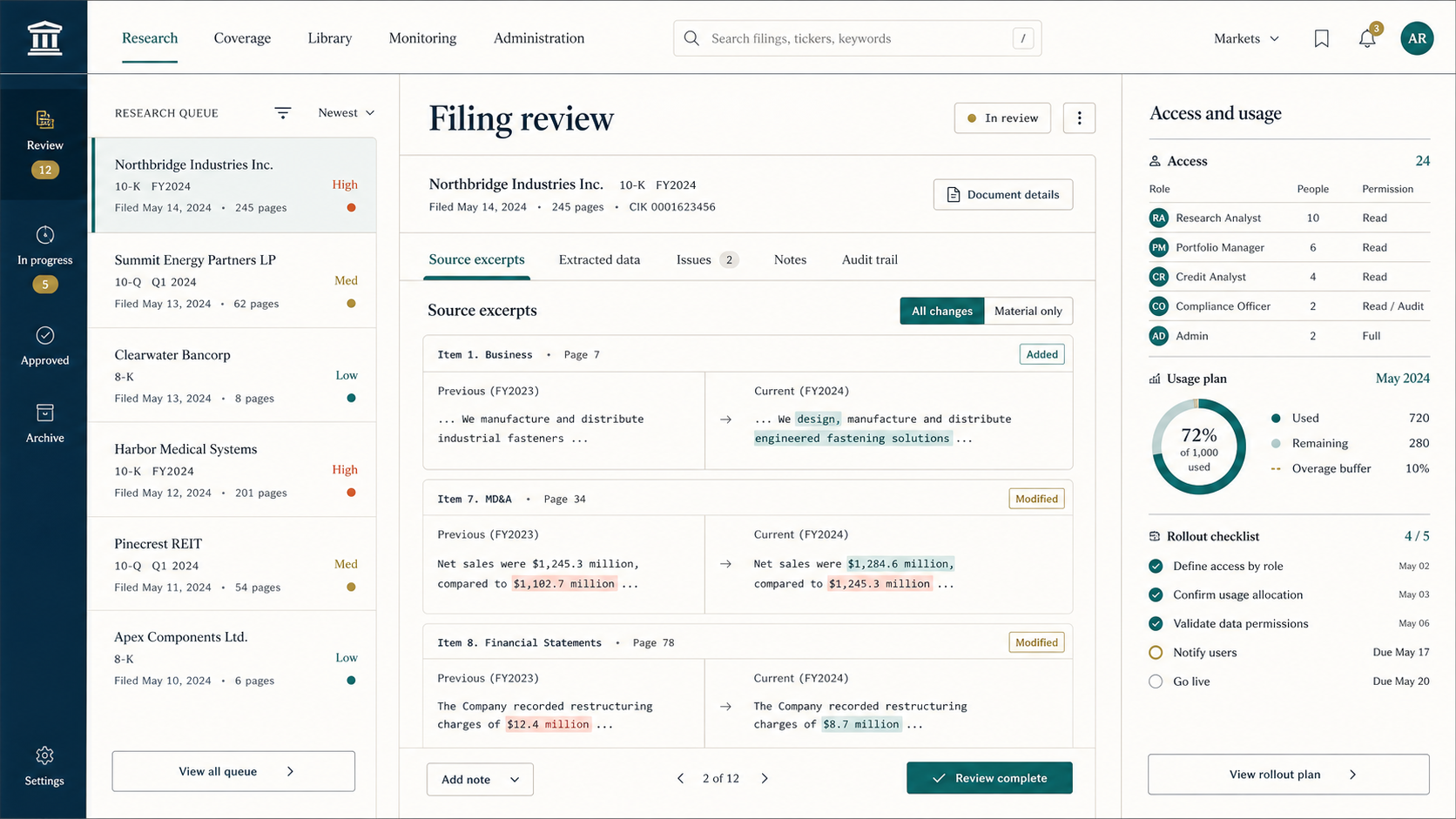
The API is only one layer. A finished experience gives researchers a place to review source changes while the people responsible for access and usage can see what is happening around it.
Review the original passage before relying on the summary.
Keep usage and ownership visible as adoption grows.
Use a rollout checklist that has real operational questions in it.
Bring Quan into the places decisions already happen.
Each path starts small and becomes more useful as it is connected to the source material, product surface, and operating model around it.
Research and filing review.
Route 10-Ks, 10-Qs, earnings materials, and coverage changes into a review queue that lets people compare the model's view with the original record.
Finance features inside your product.
Build market context, portfolio analysis, and finance-aware explanations into the experience your users already know, with a backend that keeps the API key and data checks where they belong.
Shared tools with a clear owner.
Give internal tools an access model, a usage plan, and a route for security and procurement questions before they turn into a handoff problem.
A practical way to decide whether it fits.
The goal is not to promise every control up front. It is to understand the workflow, validate the technical fit, and agree on what needs to be true before broader use.
Bring a real use case.
Share the question, source material, expected response, and who needs to rely on it. A concrete use case makes the technical review faster and more honest.
Test the integration.
Run a small version through your own backend, interface, and data checks. Confirm model behavior, response time, source treatment, and cost before expanding scope.
Plan the operating model.
Work through access, attribution, usage allocation, support needs, grounding, and data handling with the people who will own those decisions.
Start with the finance workflow that deserves a closer look.
Bring the question your team is already spending time on. We can use it to evaluate the API, the implementation path, and the operating requirements around it.
StockUp provides research software and developer tools. It does not provide investment, tax, legal, compliance, or personalized financial advice.
For Companies 100+ Employees
Get access to the best finance AI.Quan API Enterprise.
Give your company a finance-native AI API for market-aware answers, internal research workflows, SEC filing review, portfolio and coverage intelligence, and custom analytics products.
What this helps a company do
Review filings and coverage lists through the same repeatable API flow your internal tools can call, then route findings into research notes, dashboards, or analyst queues.
Built for Company-Scale Financial AI
Quan API Enterprise is built for teams that need finance-specific reasoning, organization access, security review, usage planning, and custom commercial terms beyond self-serve developer usage.
Financial AI built for markets
Move beyond broad answers with workflows tuned for filings, coverage lists, earnings risk, valuation context, and market-aware reasoning.
Use cases: SEC filing summaries, earnings-quality checks, valuation context, ticker-aware market explanations, and repeatable coverage reviews.
Enterprise benefitFinance-specific workflows can be embedded into internal tools instead of relying on browser-only research.
StatusSelf-serve API is available today; Enterprise review handles workflow design, usage planning, and commercial access.
ExampleA research team routes new 10-Q filings through Quan and flags balance-sheet risk before analyst review.
Private deployment planning
Enterprise access is planned around no Quan prompt or response storage, subject to final backend and provider configuration.
What expands here: data-handling planning, provider configuration review, and a careful split between current public API behavior and future enterprise setup.
Enterprise benefitSecurity teams can review retention, grounding, and training-use assumptions before production rollout.
StatusNo Quan prompt/response storage is a planned enterprise target, not the current public API guarantee.
ExampleA company requests a zero-retention review and decides whether grounded web search fits its data policy.
Organization access
Plan for multiple employees, admin-managed access, team-level governance, and employee onboarding instead of one-off individual keys.
Use cases: shared API access for research, product, engineering, and operations teams with clearer ownership than isolated developer accounts.
Enterprise benefitCentralized planning for seats, access, key ownership, and usage oversight.
StatusOrganization controls are part of the Enterprise rollout path and are reviewed before company activation.
ExampleAn admin creates access for analysts and product engineers under one company-level onboarding path.
Custom volume pricing
Explore committed usage, lower model rates, and commercial terms designed for company-scale research and product workloads.
Commercial fit: enterprise conversations can account for expected token volume, model mix, grounding needs, and support/security requirements.
Enterprise benefitCompanies can plan around committed usage instead of treating every workload like a self-serve experiment.
StatusCustom rates are a commercial planning path; billing logic is not changed by this landing page.
ExampleA product team forecasts monthly research volume and asks for lower rates across Quan models.
Stock
Visual element
Interactive visual elements
Preview dashboard-style visuals for team research workflows.
Cycle through sample stocks and Quan-style visual elements sized for internal portals, analyst workspaces, and company dashboards.
Choose Your Team
Different enterprise buyers care about different details. Pick a team to see where Quan API Enterprise fits.
Research Teams
Turn market context into repeatable research workflows.
Research teams can use Quan to triage filings, compare earnings risk, review coverage lists, and turn market context into analyst-ready signals without starting from a blank chat prompt every time.
Today, small teams and solo builders can start with the self-serve Developer API. Enterprise review supports company-wide access, security review, and custom commercial terms before broader rollout.
Best fitCoverage monitoring, filing review, earnings prep, and portfolio-level risk triage.
Why it mattersQuan is designed around finance language and API workflows, not just general-purpose search answers.
Example rolloutStart with one coverage workflow, then expand into watchlist scoring and internal analyst dashboards.
What Companies Can Build
Internal research tools and customer-facing finance features powered by Quan's market-aware reasoning.
Internal filing research
Route 10-K, 10-Q, earnings, and disclosure review into company research systems with finance-aware summaries and risk flags.
Market-aware product copilots
Build customer-facing or employee-facing finance assistants that understand tickers, events, filings, and portfolio context.
Coverage intelligence pipelines
Score watchlists, sector coverage, earnings events, and valuation changes with repeatable API workflows instead of manual research queues.
Purpose-Built Beyond General AI Search
General AI answer engines and broad research tools are useful for open-ended search. Companies that need finance-specific API workflows need different controls.
Enterprise Advantage
Why companies evaluate Quan
Broad AI research products are often optimized for general answers. Quan is positioned as a finance-native API layer for teams that need market context, model routing, cost controls, security review, and repeatable product integrations.
The Enterprise path is for companies that want StockUp and Quan closer to their internal workflows, not just another browser-based answer surface.
SEC and market workflows Filings, earnings, coverage, valuations
Company controls Organization access, pricing, security review
Access Model
Self-serve API vs. Quan API Enterprise
The self-serve Developer API is the fastest path for solo developers, small teams, and early product builders. Quan API Enterprise is the company rollout path for organization-level planning, procurement, security review, team governance, and custom economics.
Capability
Developer API
Quan API Enterprise
Access
Self-serve account and individual API keys.
Organization onboarding with multiple employees and admin-managed access.
Enterprise path: access is reviewed around a company relationship instead of isolated developer accounts. The goal is employee access, admin ownership, usage planning, and clearer API-key governance.
Pricing
Prepaid wallet and metered self-serve usage.
Custom volume pricing for committed usage and company-scale workloads.
Commercial planning: companies can discuss expected request volume, model mix, grounding needs, and support/security requirements. This landing page does not change billing logic; it opens the Enterprise review path.
Security
Standard public API controls and published terms.
Security questionnaire and contract review before activation.
Review scope: enterprise conversations can cover key handling, organization access, operational controls, provider configuration, and acceptable use. The current public API remains governed by the current public terms.
Data handling
Current public API terms apply, including existing logging language.
Planned no Quan prompt/response storage, subject to enterprise configuration and provider constraints.
Careful promise: no Quan prompt/response storage is a planned enterprise target, not the current public API guarantee. Provider logging, abuse monitoring, and grounded search behavior must be reviewed before any zero-retention claim is made.
Built for Enterprise Review
Security, data handling, and deployment planning without overstating the current public API guarantee.
Security review ready
Enterprise review supports contract review, security questionnaires, API key governance, company rollout planning, and deployment planning.
No training-use positioning
Enterprise access is planned around paid provider infrastructure where prompts and responses are not used for model improvement.
Grounding configuration review
Zero-retention requirements may affect web grounding choices and should be confirmed during enterprise onboarding.
Enterprise Integration Paths
Where Quan can sit inside company workflows.
Research Teams
Coverage and filing intelligence
Use Quan to triage filings, summarize earnings changes, and surface risk themes across company watchlists.
SECContext
RiskSignals
APIWorkflows
Product Teams
Finance-aware customer features
Embed stock-aware explanations, market move context, and portfolio intelligence into company products.
AppsEmbedded
QuanModels
ScalePricing
Operations Teams
Governed AI research access
Plan employee access, API governance, usage economics, and security requirements before rollout.
OrgAccess
LegalReview
DataControls
Frequently Asked Questions
Answers for companies evaluating Quan API Enterprise.
Is Quan API Enterprise ready today?
Enterprise review is live for companies evaluating organization access, security review, usage planning, and custom commercial terms. The self-serve Developer API remains available at /api for immediate testing.
How is this different from general AI answer engines?
General-purpose AI search is useful for broad research. Quan API Enterprise is positioned for finance-specific API workflows: SEC filings, market context, ticker-aware analysis, model routing, cost planning, and security review.
Is enterprise data used for training?
Enterprise will be structured around paid provider infrastructure where prompts and responses are not used for model improvement. Final language should be confirmed during legal and security review.
Can Enterprise support zero retention?
Possible only with the right enterprise provider configuration and limitations around grounding. The standard public API should not be described as zero-retention today.
Can multiple employees get access?
Planned via organization onboarding, with employee accounts, admin-managed access, and team-level governance to be designed before activation.
Are the plan prices and token pools flexible?
Yes. The listed plans are starting points for Enterprise conversations. StockUp can adjust pricing, token pools, seats, support structure, grounding treatment, rollout timing, and commercial terms when a company contacts us with a real deployment plan.
What if our project is too small for Enterprise?
Solo developers, small teams, prototypes, and medium-scale products can start with the lower-cost self-serve StockUp Quan Developer API. Enterprise is intended for organizations that need team governance, employee quotas, custom pricing, security review, procurement review, or larger token pools.
Where can legal or technical teams review the current terms?
Current public terms are available at Terms, current privacy language is available at Privacy, and the Enterprise Terms Addendum is available at Enterprise Terms.
Give your company a finance-native AI API.
Request a demo to discuss organization access, expected usage, security requirements, model pricing, and whether your deployment needs no-retention architecture or grounded web search. Solo developers, small teams, and early product builders can start immediately with the self-serve Developer API.
Manage company access, API keys, model usage, and playground testing for your Quan API Enterprise organization.
No plan selected
No plan selected. A plan is required to add accounts to your dashboard and unlock more Enterprise controls.
Choose your Plan.
Select the account range and token pool that best matches your rollout. These plans are flexible starting points; StockUp can adjust pricing, tokens, seats, support structure, and rollout design when contacted. Smaller and medium-scale projects can start with the lower-cost Developer API, and small teams can see StockUp Quan for Teams before committing to a full Enterprise rollout.
1-100 accounts
Team Enterprise
Best for internal research teams, pilots, and department-level rollout.
Starting at $499/moFlexible starting price; final terms can adjust around usage, tokens, security review, model mix, grounding behavior, and contract structure.
Monthly org token pool25M tokens
Planning guide250k/user
Quan 3.4 and Deep Research access, subject to token pool and Enterprise usage review
No separate grounding fee shown to customer
Org dashboard, Enterprise API keys, and usage analytics
Admin-managed employee access and temporary-password onboarding
Priority onboarding for first workflow setup
Private Enterprise data-handling review
Audit logs planned for admin actions and key events
Planned around no Quan prompt/response storage, subject to Enterprise configuration
Most popular
100-5,000 accounts
Business Enterprise
For company-wide groups that need access governance, onboarding planning, and usage review.
Starting at $3,999/moFlexible starting price; final terms can adjust around usage, tokens, security review, model mix, grounding behavior, and contract structure.
Monthly org token pool500M tokens
Planning guide100k/user
Quan 3.4 and Deep Research access, subject to token pool and Enterprise usage review
No separate grounding fee shown to customer
Everything in Team Enterprise
Department rollout planning and quarterly usage review
Access governance support and admin controls
Security questionnaire support
Priority support for production workflows
Monthly model-mix and token-planning review
Private Enterprise data-handling review
Custom token planning across teams
5,000+ accounts
Enterprise Scale
For large-scale rollouts with custom user/token pool planning and a base platform commitment.
Starting at $19,999/mo and upFlexible starting price; final terms can adjust around usage, tokens, security review, model mix, grounding behavior, and contract structure.
Monthly org token poolStarts at 2B
Planning guideCustom pool
Quan 3.4 and Deep Research access, subject to token pool and Enterprise usage review
No separate grounding fee shown to customer
Everything in Business Enterprise
Custom deployment and security planning
Dedicated rollout and procurement coordination
Executive rollout review for large organizations
Custom Deep Research and grounding usage review
Network, retention, and provider-configuration review
Priority escalation path for production incidents
Private Enterprise data-handling review
Custom token pools for enterprise-wide usage
Org Status--
Active Seats0
Requests0
Total Tokens0
Enterprise Setup
This first run creates the company workspace, separates Enterprise users from normal StockUp user profiles, and lets admins manage temporary-password employee access. Contract pricing, provider configuration, and formal no-retention terms still require later review.
API Keys
Enterprise Model Access
Enterprise accounts can test Quan API models while planning token pools, private Enterprise data-handling review, and custom usage terms. The live endpoint accepts Enterprise keys and records usage at the organization level.
Flagship finance model
Quan 3.4
Balanced finance reasoning for market-aware answers, valuation context, and product integrations.
WorkloadMarket answers, valuation, SEC context
LatencyBalanced response speed
Token Pool FitTeam and Business workloads
ContextLarge financial research prompts
GroundingAvailable; no separate customer fee
Best UseEmbedded finance copilots and dashboards
Deep Research workload
Quan 3.4 Deep Research
Higher-depth reasoning for filings, earnings, coverage lists, portfolio review, and multi-step analysis.
WorkloadSEC review, earnings risk, due diligence
LatencyReasoning-first responses
Token Pool FitBusiness and Scale research
ContextLonger documents and research packs
GroundingAvailable; no separate customer fee
Best UseAnalyst queues and investment research workflows
Fast utility model
Quan 3.0
Lower-latency finance workflows for alerts, routing, ticker parsing, and lightweight internal tools.
WorkloadClassification, routing, fast summaries
LatencyFastest Enterprise option
Token Pool FitHigh-volume internal utilities
ContextShorter prompts and event streams
GroundingUsually off for speed
Best UseAlerts, watchlists, and ticker-level preprocessing
Enterprise Playground Response
Select an Enterprise key and run a request.
Manage Access
Admins can add employees, set roles, update temporary passwords, and disable access.
Add User
Select an Enterprise plan before adding employee accounts.
Required for new Enterprise-created users. Existing StockUp logins keep their current password.
Enterprise access
Sign In to Enterprise
Access your company Quan API workspace.
Use your existing StockUp login or create a separate Enterprise account. If you already use StockUp with Google, continue with Google first, then create your Enterprise organization.
Required for Enterprise workspace access
Review the Enterprise Terms
Every active Enterprise member must review and accept the current Enterprise Terms before using the Dashboard or Playground.
Organization token pools, user quotas, model access, support, and billing follow your Enterprise agreement.
StockUp works to reduce provider training and retention where controls are available, but cannot guarantee zero retention or zero training use unless a signed agreement says so.
Direct Enterprise API keys remain usable. This gate controls access to the signed-in Enterprise workspace.
Plan request
Request Enterprise Plan
Review the prebuilt message, then email StockUp or record the request on your Enterprise workspace.