
 : AI stock research and reports
Financial research,
carried through.
Take on the complex question. Work from the evidence.
Make something worth sharing.
Can we
answer it?
Some questions need a calculation. Others need more evidence. See how Quan works through both.
Put the evidence to work.
The question
“What was my whole portfolio’s return? History covers 76.8% of it. Don’t use a proxy.”
- Listed holdings
- 76.8% of portfolio
- Private fund
- 23.2% of portfolio
- Covered holdings’ return
- −8.00%
- Instruction
- No proxy returns
Every conclusion needs something to stand on.
The missing holding matters.
The covered holdings can be analyzed. The whole-portfolio return cannot be established while the private fund’s return is unknown.
23.2% of the portfolio is still unaccounted for.
What we can establish
- Covered portfolio weight
- 76.8%
- Listed holdings’ return
- −8.00%
What is still needed
The private fund’s return over the same period.
An unknown return cannot be treated as zero.
See what changes when the missing input arrives.
A useful answer includes
its limits.
Quan 3.5 can separate a complex request, work with supplied inputs, and identify the evidence a conclusion still needs.
Meet Documents.
Read the source.
Keep the work.
The research doesn’t have
to end in a chat.
Bring PDFs into your analysis. Ask questions grounded in their contents. Turn the result into a structured document you can read, download, and share.
Start with the sourceUse filings, earnings releases, and other PDF material in your research.
Follow the evidenceKeep reported results, calculations, and missing information distinct.
Take a document with youExport research with sections, tables, charts, and source references.
Generated by Quan 3.5 on 31 October 2026 from SEC filings and market data, shown as produced. Not investment advice.
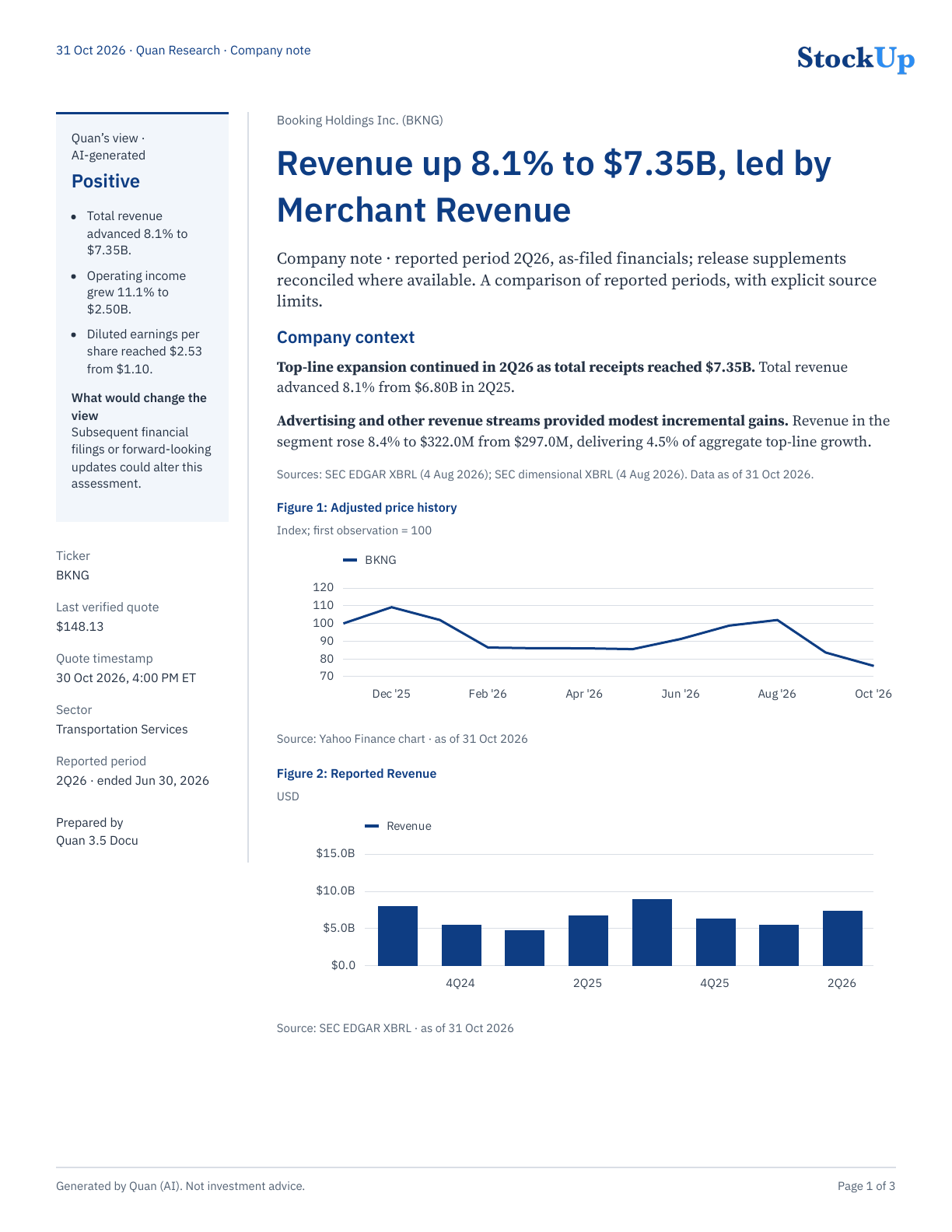
Look inside the reports
Built for
the details.
For the questions where the method matters as much as the answer.
Complex research
Ask a multi-part question. Quan 3.5 separates the work into independent research tasks, keeping each task’s instructions attached to its answer.
“Explain the portfolio risk, examine the valuation, and identify what data is still missing.”
Quantitative reasoning
Calculate technical indicators from verified price history. Use explicit valuation assumptions and requested time horizons. Keep the calculation connected to its inputs.
Moving averages, RSI, portfolio risk, and scenario-based valuation.
Context that carries
Follow up on a company without restating its ticker. Keep user-stated portfolio constraints in view across the conversation, rather than starting the analysis over.
“Keep the same position limit. What changes if the cash balance is unknown?”
Evidence you can inspect
Work with primary-source financial context, reported periods, and observation dates. When evidence is incomplete, the answer can explain which conclusions are blocked.
A missing holding’s returns stay missing. They are not silently replaced with a proxy.
Answers at your level
Choose simple, balanced, or advanced explanations. Start with the overall conclusion, then work through the supporting detail at the level your research needs.
Built for learning the terms as well as scrutinizing the method.
In your
workflow.
Research in Quan’s workspace. Build with Quan through the API. Put the same finance-focused capabilities where your team already works.
Explore the developer platformModel access and document availability depend on your account and enabled features.
Use your own API key in a server-side environment.
Your next
question.
Quan 3.5 and Documents.
From the first question to the finished work.