Quan 3.5 is StockUp's new AI model for stock and financial research, and you can use it today. We built it for people who ask hard questions about companies and portfolios: investors doing their own research, finance teams, developers, and people learning how financial research works. It runs on StockUp, in the Quan workspace at quan.stockup.cc, and through the StockUp API. A free account includes three Quan 3.5 answers a month and enough credits for one research report.
The short version of what changed: Quan 3.5 takes the whole question, works from the filings, shows arithmetic you can redo, and can hand you a finished report at the end.
What's new in Quan 3.5
Ask the whole question
Real research questions rarely arrive one at a time. You might want the risk in a portfolio, a view on valuation, and a list of what you still don't know, all in one message. Quan 3.5 splits a request like that into its parts and answers each in its own section, so the instructions for one part stay with that part.
It also keeps track of the conversation. Once you've named a company, a follow-up can just say "it." If you set a limit earlier, such as a maximum position size, Quan 3.5 keeps applying it in later turns. When you give a new value, the new one wins. You can also type your holdings straight into the question and Quan will use them as your portfolio, while still checking that each ticker is real.
Answers that start from the filings
Ask about one company's results and Quan 3.5 looks up the latest reported period in the company's SEC filings, then works from those numbers.
When something can't be found, the answer says that. A missing figure is reported as missing. If part of your portfolio has no return history, Quan won't swap in a proxy, and it won't treat the unknown return as zero. It tells you which conclusions the gap blocks. Cash works the same way: if you haven't said how much cash you hold, Quan 3.5 won't assume a balance, and it turns down a request that only works if it does. We would rather give you a shorter answer that names the missing input than a confident one built on a guess.
Arithmetic you can check
Portfolio weights never add up to more than 100%. Risk metrics use their standard definitions, including the Sortino ratio, Wilder's RSI and compounded returns. When a metric needs a risk-free rate, the answer reports the rate it used and flags it if that rate was assumed rather than given by you.
For a discounted cash flow, Quan 3.5 uses the inputs written in your question, along with the horizon and cash flow timing you specify, in a single-stage model. Moving averages, the 52-week range and average volume are computed from verified daily price data. Because the inputs stay attached to the result, you can rebuild any of it in a spreadsheet.
Answers at your level
Choose a balanced answer (the default), a simple one, or an advanced one. Simple suits someone still learning the terms. Advanced suits someone who wants to pick apart the method. The style changes how the answer explains things, not what it says: every style uses the same figures and the same checks.
Documents: research reports you can keep
Research doesn't have to end in a chat window. With Documents, you can bring PDFs such as filings and earnings releases into your analysis, ask questions grounded in them, and turn the result into a structured report with sections, tables, charts and source references. You can read it, download it and share it.
Here are two real reports Quan 3.5 generated on October 31, 2026 from SEC filings and market data, shown as produced.
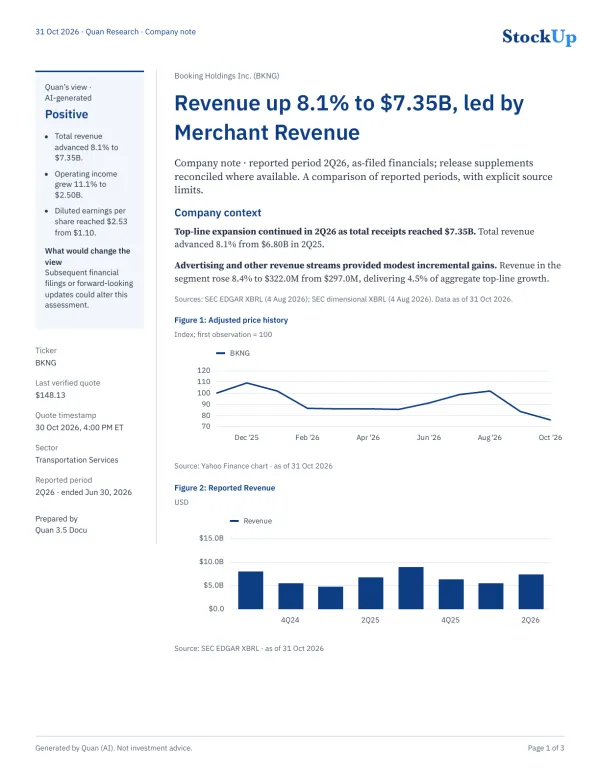
The Booking Holdings company note leads with "Revenue up 8.1% to $7.35B, led by Merchant Revenue." Its summary table puts operating income at $2.50B against $2.25B a year earlier, and diluted EPS at $2.53 against $1.10. Gross profit is listed as "Not available." Page 3 lists the gaps it found, including segment operating income, which the company doesn't report by segment. Where the earnings release gave no reason for the jump in diluted EPS, the note says it found none. It ends with a verification note: "Quan removed 1 statement it could not verify against the sources."
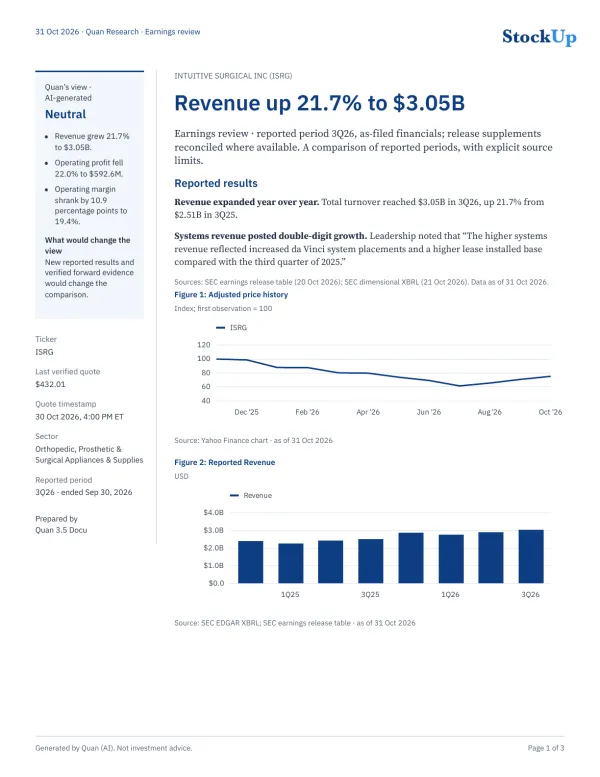
The Intuitive Surgical earnings review covers a more mixed quarter. Revenue grew 21.7% to $3.05B while operating profit fell 22.0% to $592.6M, and operating margin dropped 10.9 percentage points to 19.4%. Net income and diluted EPS show "Not available" in the table, not an estimate.
Both reports end with their sources and dates, including the accession number and filing date of each SEC filing they used. Both are in the report library, and you can walk through the features on the Quan 3.5 showcase.
A 2 to 4 page report costs 150 credits, which is $1.50 (one credit is one cent). New Starter accounts get 150 welcome credits after verifying their email, so the first report is free.
Plans and pricing
| Plan | Price | Quan 3.5 | Credits |
|---|---|---|---|
| Starter | Free | 3 answers a month | 150 once, after email verification |
| Plus | $12 a month$10 a month for the first 100 subscribers, kept while subscribed | 2M tokens a month (about 90 answers) | 500 a month |
| Pro | $20 a month | 4M tokens a month (about 180 answers) | 1,000 a month |
Annual billing is $120 a year for Plus and $200 a year for Pro. Anyone signed in can buy credit packs, starting at 500 credits for $5, and credits you buy don't expire. Quan 3.4L daily allowances haven't changed and don't count against your Quan 3.5 usage. The full breakdown is on the plans page and in our post on the new plans.
For developers
Quan 3.5 is in the StockUp API as quan-3.5, on the same endpoint as other Quan models. It costs $5.50 per 1M input tokens and $28.00 per 1M output tokens, and output includes thinking tokens. There is no free allowance on 3.5, so you need a prepaid balance. A request looks like this:
curl -X POST https://stockup.cc/v1/query \
  -H "Content-Type: application/json" \
  -H "x-api-key: STOCKUP_API_KEY" \
  -d '{
    "model": "quan-3.5",
    "messages": [
      { "role": "user", "content": "Summarize the latest reported quarter. List any figures you could not verify." }
    ],
    "answerStyle": "advanced",
    "stream": false
  }'
Two things differ from Quan 3.4. Responses come back as JSON unless you send "stream": true, and the new answerStyle field takes balanced, simple or advanced. When an answer comes from Quan's response cache, you aren't charged for its tokens or searches.
Launch credit. Redeem the code QUAN35 in the developer console. The first 100 developers to redeem it get $5.00 of API credit for quan-3.5 requests. It's one per account, needs a verified email and the current Developer API Terms, and expires after 60 days.
Also note: Quan 3.4's API price goes from $2.50 / $15.00 to $3.00 / $18.00 per 1M input / output tokens on December 15, 2026.
The Quan 3.5 API guide covers streaming, billing headers, errors and examples in JavaScript and Python. The reference lives in the API docs.
What Quan 3.5 can't promise
Quan 3.5 is an AI model, and it can be wrong. It can misread a question or a document, and the data it works from can be incomplete or out of date. If the latest filing can't be retrieved, Quan still answers, just without it. Before you rely on a figure, check it against the filing it came from. The reports print their sources and dates to make that easier.
We also aren't publishing speed or accuracy numbers with this launch, so you won't find any in this post. Quan is a tool for research and education. Nothing it writes is investment advice.
Try Quan 3.5 today
- Open StockUp or quan.stockup.cc and choose Quan 3.5 in the model picker.
- Create a free account and verify your email. That gives you three Quan 3.5 answers a month and 150 credits for a report.
- Ask about a company you follow, all of it at once: the latest quarter, the valuation, and what's still unknown.
- If you build software, get a key in the developer console and redeem
QUAN35while launch credits last.
Frequently asked questions
What is Quan 3.5?
Quan 3.5 is StockUp's AI model for stock and financial research, released on November 1, 2026. It answers multi-part questions section by section, works from the latest results reported in SEC filings, says which data is missing instead of guessing, and can turn research into a PDF report. It is available on StockUp, at quan.stockup.cc, and through the StockUp API as quan-3.5.
Can I use Quan 3.5 for free?
Yes. A free Starter account includes three Quan 3.5 answers a month. After you verify your email, StockUp adds 150 welcome credits once, which pays for one 2 to 4 page research report. Plus ($12 a month) and Pro ($20 a month) include monthly Quan 3.5 token allowances.
Where does Quan 3.5 get its financial data?
For questions about one company's results, Quan 3.5 starts from the latest reported period in the company's SEC filings. Technical indicators are computed from verified daily price data. Research reports list each source with its date, and figures that could not be verified are marked as not available.
How much does a Quan 3.5 research report cost?
A 2 to 4 page report costs 150 credits, which is $1.50. One credit is one cent. Plus includes 500 credits a month, Pro includes 1,000, and new Starter accounts get 150 credits once after email verification.
How do developers use Quan 3.5 in the API?
Send requests to https://stockup.cc/v1/query with the model id quan-3.5 and your key in the x-api-key header. Quan 3.5 costs $5.50 per 1M input tokens and $28.00 per 1M output tokens and needs a prepaid balance. The first 100 developers to redeem the code QUAN35 in the developer console get $5.00 of Quan 3.5 credit, which expires after 60 days.
Is Quan 3.5 investment advice?
No. Quan 3.5 is an AI research and education tool, and it can be wrong. Check important figures against the original filings before you rely on them.