You can get free AI stock analysis on StockUp in three ways. Quan 3.4L answers stock questions every day, even without an account. A free Starter account adds three Quan 3.5 answers a month. And when you verify your email, you get 150 credits, enough for one 2 to 4 page research report.
This guide covers what each free option gives you, what a useful AI stock analysis should contain, and how to get the most out of the free allowance before deciding whether a plan is worth it.
What's free on StockUp
StockUp has two models you can use without paying. Quan 3.4L is the lighter one, with a daily allowance. Quan 3.5 is the newer model, with a small monthly allowance on the free plan. Here is the whole picture, including the paid plans for comparison.
| Access | Price | Quan 3.4L | Quan 3.5 | Credits |
|---|---|---|---|---|
| Guest | Free, no account | 75,000 tokens a day | Create a free account | None |
| Starter | Free | 150,000 tokens a day | 3 answers a month | 150 once, after email verification |
| Plus | $12 a month | 1,000,000 tokens a day | 2,000,000 tokens a month (about 90 answers) | 500 a month |
| Pro | $20 a month | 3,000,000 tokens a day | 4,000,000 tokens a month (about 180 answers) | 1,000 a month |
Tokens measure how much text Quan reads and writes, so a short question uses less than a detailed comparison. Your Quan 3.4L usage doesn't count against your Quan 3.5 allowance. One credit is one cent, and a 2 to 4 page report costs 150 credits. The full details are on the plans page and in our post on the new StockUp plans.
What a useful AI stock analysis includes
Free or paid, an analysis is only as good as its evidence. Before you trust one, check that it has these:
- Reported results with dates. Which quarter, when it ended, and what it is compared with.
- Figures that were calculated, not guessed. Growth rates, margins and moving averages should come from reported data and real price history.
- Stated assumptions. A valuation only means something next to its inputs: growth rate, discount rate and time horizon.
- Risks, not just the upside. What could go wrong, and what would change the view.
- Sources and "as of" dates, so you can check the numbers and know how fresh they are.
- Disclosed gaps. If a number couldn't be found or verified, the analysis should say so rather than fill it in.
How to get a free AI stock analysis, step by step
- Start as a guest with Quan 3.4L. Open stockup.cc and ask a question about a stock. You don't need an account, and guests get 75,000 tokens of Quan 3.4L a day. It's a good place for quick questions about a company or a financial term.
- Create a free Starter account. Signing in doubles your daily Quan 3.4L allowance to 150,000 tokens and adds 3 Quan 3.5 answers a month.
- Save Quan 3.5 for the hard question. With three answers a month, use Quan 3.5 for the question that needs real analysis, such as a company's latest reported quarter, what moved its margins, and what data is missing.
- Verify your email and use your welcome credits on a report. Verification adds 150 credits, which pays for one 2 to 4 page PDF report with tables, charts and a list of sources. Quan shows the credit cost before it starts writing.
- Check the key figures yourself. Open the filings listed in the sources and confirm any number you plan to rely on. AI-generated analysis can contain errors.
Start with a question you already have. No account is needed for Quan 3.4L, and a free account adds 3 Quan 3.5 answers a month.
Try Quan 3.5 freeGetting more out of three Quan 3.5 answers
Three answers go further when each question is specific. A few habits that suit how Quan 3.5 works:
- Put the parts in one message. Quan 3.5 can split a question with several parts and answer each part separately. For example: "Summarize this company's latest reported quarter, explain what moved its operating margin, and list what data is missing."
- Follow up without repeating yourself. A ticker named earlier in the conversation is used when your next message refers back to it, and limits you stated earlier, such as a maximum position size, are carried forward.
- Say what you don't know. If part of your portfolio's balance is unknown, say so. Quan 3.5 won't treat an unknown balance as cash.
- Pick an answer style. Simple, balanced or advanced. The figures and checks are the same in each; only the explanation changes.
How Quan 3.5 approaches a stock analysis
For analytical questions about a single company, Quan 3.5 reads the most recently reported period from the company's SEC filings before answering. Moving averages, the 52-week range and average volume are computed from a verified daily price series. Everyday questions, such as a price, key figures or why a stock is moving, get a shorter answer that is checked against the data retrieved for the question and rewritten if it fails the check. When a risk calculation uses a risk-free rate, the rate is reported, and marked when it is an assumption.
The free report shows this most clearly. In the sample Booking Holdings company note, revenue rose 8.1% to $7.35 billion and operating margin moved from 33.1% to 34.0%. The last page lists what is missing, such as gross profit, which had no standalone quarterly figure, and segment operating income, which the company does not report by segment.
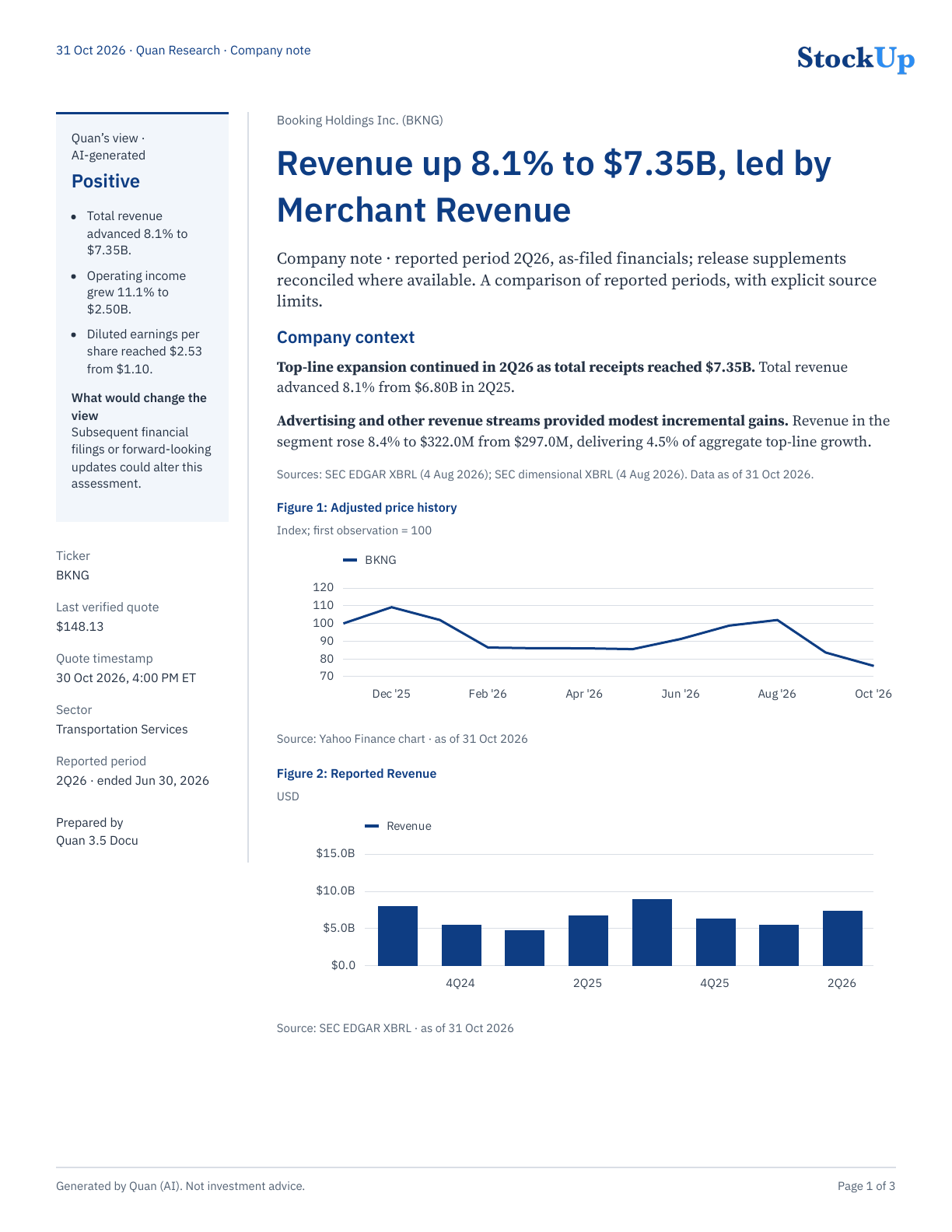
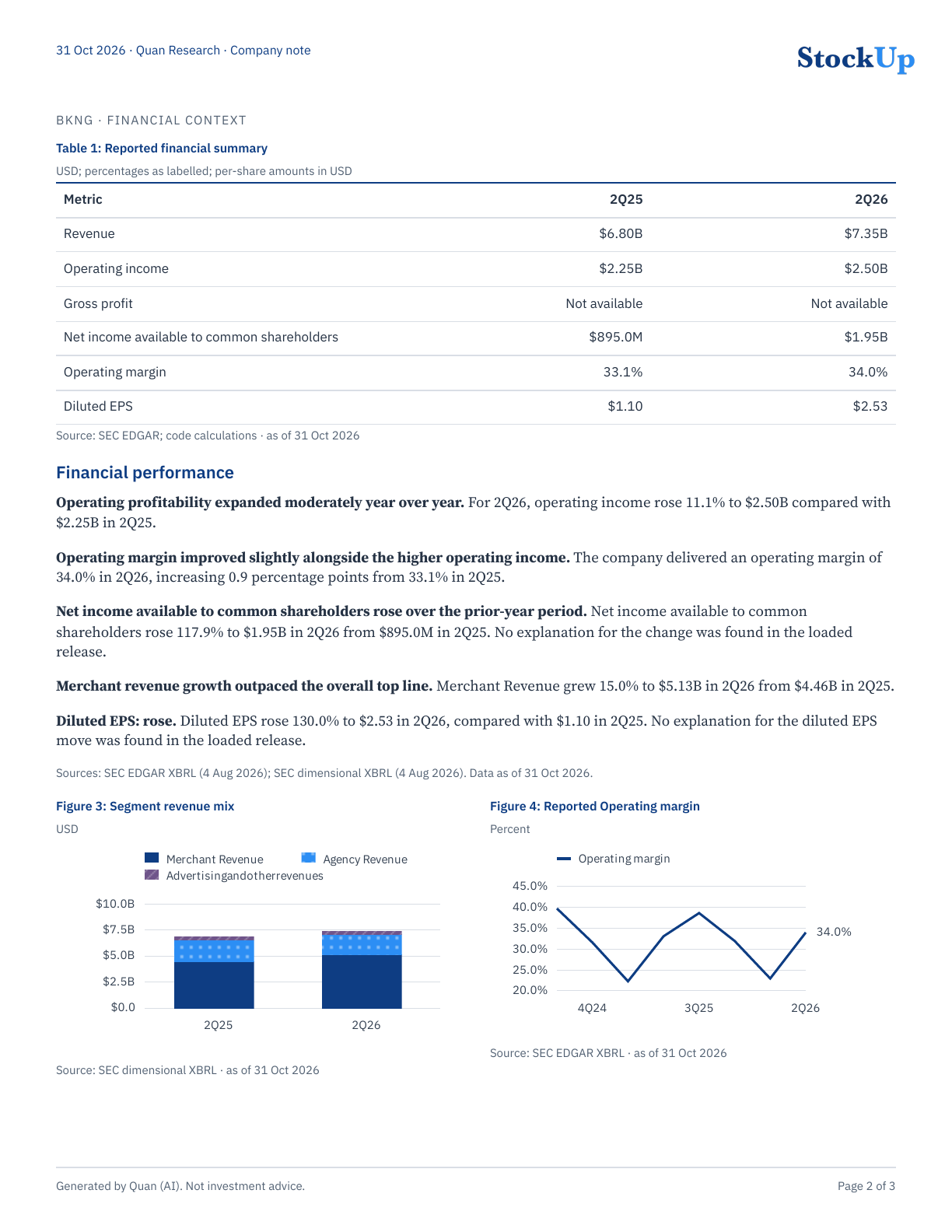
See both sample reports in the report gallery, or read the Quan 3.5 overview. If you want a closer look at earnings, our guide to AI earnings report summaries walks through one report step by step.
What free AI stock analysis can't do
- It isn't advice. Quan describes and explains. It doesn't know your situation and doesn't tell you what to buy or sell.
- It can be wrong. Any AI can misread a figure or mix up periods. Check the numbers that matter against the filing.
- Data can be incomplete or stale. Reports carry "as of" dates and a missing-data section for this reason.
- It can't predict prices. It can show what was reported and what analysts expect. It can't tell you what the stock will do next.
AI-generated analysis; not investment advice. Quan can make mistakes. Check any figure you plan to rely on against the original filing, and make your own decisions.
When paying makes sense
If three Quan 3.5 answers a month runs out quickly, Plus at $12 a month includes 2,000,000 Quan 3.5 tokens a month (about 90 answers) and 500 credits, enough for three reports. Pro at $20 a month doubles the tokens and includes 1,000 credits. If you only want more reports, anyone signed in can buy credits, starting at 500 for $5.00, on any plan including Starter.
Frequently asked questions
Is StockUp's AI stock analysis really free?
Yes. Quan 3.4L is free every day, with 75,000 tokens for guests and 150,000 for free accounts. A free Starter account also includes 3 Quan 3.5 answers a month and 150 welcome credits for one report after you verify your email.
Do I need an account?
Not for Quan 3.4L. You need a free account for the Quan 3.5 answers, and a verified email for the welcome credits.
What is the difference between Quan 3.4L and Quan 3.5?
Quan 3.4L is the lighter model with a daily free allowance. Quan 3.5 is the newer model: for single-company analytical questions it reads the latest reported period from SEC filings, it can split multi-part questions, and it writes the PDF research reports.
Do the free credits expire?
No. The 150 welcome credits and any credits you buy don't expire. Credits included with Plus and Pro are a monthly allowance that resets each month.
Can I buy a report without subscribing?
Yes. Anyone signed in can buy credits on any plan, including Starter. The smallest pack is 500 credits for $5.00, and a 2 to 4 page report costs 150 credits.
Is there a free AI stock analysis API?
Quan 3.4L on the StockUp API includes a one-time allowance of 100,000 free tokens per account. Quan 3.5 on the API needs a prepaid balance and costs $5.50 per million input tokens and $28.00 per million output tokens.
Is free AI stock analysis investment advice?
No. Quan's output is AI-generated analysis for research and education. Check the figures that matter to you and make your own decisions.